All posts filed under: Essays

Arab Fashion from the Past and Present: An Under-represented Costume Tradition

From soap making and cosmetics to costume in the Abbasid Caliphate, Nehal of the blog Lugatism explores the rich history of adornment through the Middle Ages. Read on to learn why she began an odyssey into Medieval Arabo-Islamic beauty practices and costume culture. Since I was a child, I was an avid consumer of American entertainment. If an average Jane like me wanted to find out how a certain culture dressed in a chosen epoch, they could look up a movie or a show about said culture. The popularity of Hollywood and other global entertainment industries made this effort easier.  The majority of Hollywood’s historical films or period-re-enactment dramas are notorious for their, let’s say, “white-centric” portrayal. They either tell the story of a white character in a historical setting or sometimes a story set in a historical period with a white protagonist.  The woefully problematic history of Hollywood’s negative portrayal of non-white minorities has accumulated quite a long rap sheet over the years, which has garnered the disparagement of various audiences. Alongside biased and prejudiced …

The Hijab as an Alien: Neil deGrasse Tyson, Sheikh Abdul Fattah and Expansive Horizons

The thing about horizons is that they are always subjective. Opening your front door will always give way to your immediate horizon, the squeal of playing children and the clamour or alternatively the silence of life in your neighbourhood- most intriguingly the curve of the sky meeting the earth. For the astronaut finding home inside a space station, horizons don’t signify the ending but rather the expansion of things. A thought put by astrophysicist Neil deGrasse Tyson, namely that the expansion of the universe means each of us through the ages have been ‘dealt’ a new cosmos or that each of our subjective co-ordinates in relation to the edge of the universe has evolved over the epochs, means that we have all in essence witnessed different skies, different horizons. As explored by Maria Popova, ‘eating the sun’ was the pastime of blind French resistance fighter Jacques Lusseyran who lived an extraordinary life of light despite the darkness of his physiological reality. I suppose in light of this, sunsets do not have to be- as they …

k.eltinaé, borders and butterflies

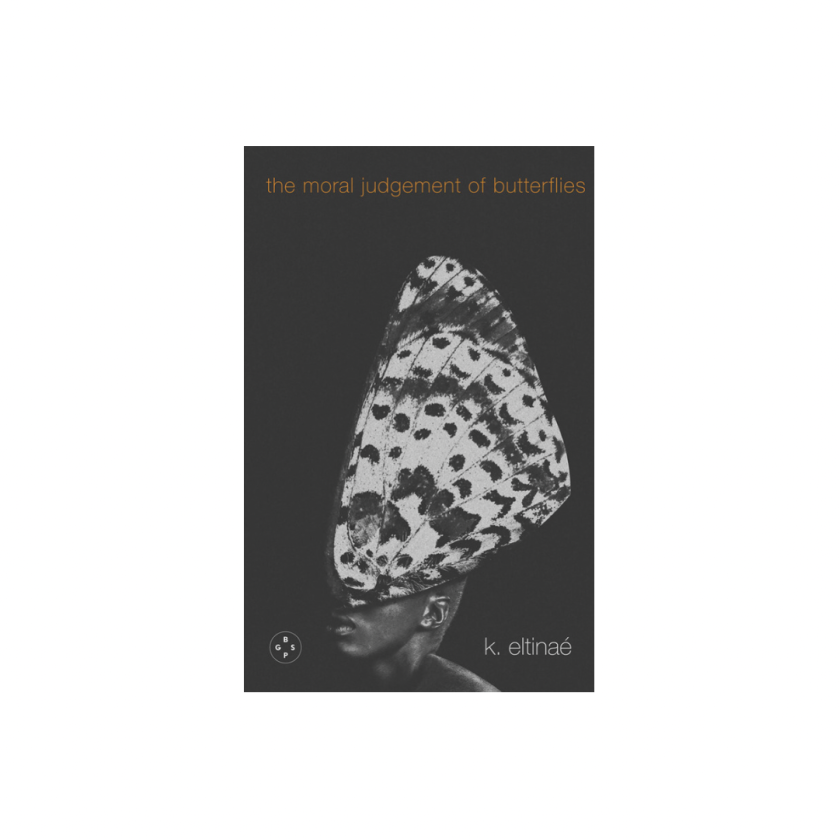
k.eltinaé is a Sudanese writer of Nubian descent and a third culture kid who with his poetry collection, negotiates borders and ideas as adroitly and beautifully as the argonaut that is the butterfly.  Vacillating between love and longing, displacement and arrival in his profound collection titled ‘the moral judgement of butterflies’ k.eltinaé’s body of work is at once arresting and searing, spiritual and heart wrenching. As my copy of his collection arrives, I eagerly open the pages to mine the words which have captured the startling rage, love and poetic musings of a writer who from culture to migration, war to peace has a lot to say about and to the world. – ‘nefsi’ I am upon the first reading drawn to read and re-read the poem ‘nefsi’ (translated from Arabic to mean ‘my soul’, ‘my own self’). For those that are on their own journey to self love / acceptance / those who are battling the troughs of their own minds and seeking words of affirmation which are just as impactful as West Indian …

Blazing a Trail: Amira the Wanderlust

Amira the Wanderlust is an adventurer in every sense of the word. Hiker, explorer, mountaineer and expedition leader as well as founder of the adventure group ‘The Wanderlust Women’, she is the contemporary Argonaut rekindling a modern take on the 15th-17th C age of exploration. Much like the anthropologist, Amira travels from region to region discovering and documenting – the only catch being that Amira is a cultural force within herself. Donned in a hijab and niqab (face veil) Amira looks starkly different to the collective imagining of a contemporary explorer. In a global society from Macron’s France and his sanctions against the hijab to the female Iranian resistance to forced/ imposed hijab, Amira is emblematic of audacious courage, existing with neither tensions as her point of reference but rather her religion and her desire to explore our home that is earth, being her guiding principles. Captured on Instagram traversing the valleys of the Lake District, the terrain of Ben Nevis or paddle boating in a National Park all while maintaining her religion and her …

O To Live! To Build a Quiet Life: Deep Time, Eschatology and the Anthropocene

ANTONIO. I hold the world but as the world, Gratiano; A stage, where every man must play a part, And mine a sad one. GRATIANO. Let me play the fool! ~The Merchant of Venice, William Shakespeare The centre, for many, seems not to be holding. Turning and turning in the widening gyre, it appears that we homosapiens have lost our way. The darkness has dropped a thousand times over and still we ignore the tensions between our profound purpose and the brevity of life… On a blue-skied afternoon in London, against the backdrop of a chorus of birdsong and the murmuring happenings of a leafy suburb, I embrace the concept that despite the socially constructed stratification of what is and what isn’t considered the ideal life, there is no real hegemony or hierarchy in one’s approach to and experience of it. To me, to live means to cultivate a quiet life. To engage with the world around us, to build meaningful relationships and to practise the avocations that make us feel most like ourselves. How …

Bedouins, Bolsheviks and Babylon: What world cultures teach us in divesting from modern capitalism

The Bolsheviks, popularising the strand of revolutionary Marxist-Leninist political thought that emerged in Russia during the early 20th believed in the complete political and economic liberation of the Russian working class and the overthrowing of the government to form a true socialist regime. Bolshevism founded and headed by Vladimir Lenin recognised the power of the working class (proletariat) in Russia and the underdevelopment of the ruling class (bourgeoise) and thus the potential for the working class to revolt and advance a classless system of political and economic egalitarianism for all people. Lenin who realised communism would not be immediately obtained in Russia, however foresaw the potential across Europe for the working class resistance and communist ideology to become successful, planning for communism to overtake Russia by degrees. The Bolshevik ideology in spite of its somewhat utopian theory had setbacks in praxis. One of them was the reality of nepotism, favouritism and corruption (also known as nomenklatura) which undermined the revolutionary communist ethos and led to the incapacitation and stagnation of socialist policy on the ground. …

Hana Mahmoud Mohamed Saey: The Soul of Palestine

SANCTUARY Two years ago, for the third year of my History and Arabic undergraduate degree, I had to choose from one of four Arab cities for a year of study abroad. I chose Nablus in Palestine. I had an idea of what my trip might be like. From a distance, Palestine somehow still felt very familiar to me. Palestine was frequently in the news for starters, often at the centre of tensions within the Middle East. But also, as a Muslim, and as the daughter of a Christian mother, for me Palestine was very much at the centre of another type of world too.  JERUSALEM It was just after dawn. Daylight was bleeding into the night sky as the moon began its slow descent into the horizon. Crowds of people quietly rushed through the narrow and winding market streets of the Old City, making their way to the Eid Prayer at Masjid al Aqsa (the Furthest Mosque). Worshipers were dressed in their finest attire and the smell of musk filled the air.  My friend took …

Scent As A Sanctuary: Aromatherapy Amongst The Tuareg

Plants have always played a vital role in the physical emotional and spiritual well being of human kind. The Tuareg of Niger are an example of a people for whom scent plays a major role in everyday life, exchange and kinship. The Taureg are a nomadic people largely scattered across North / Northwest Africa. They can be found in Mauritania, northern Nigeria, Libya, Mali, Burkina Faso, Tunisa, Algeria and Niger. The Tuareg are instantly recognisable as the ‘blue men’ due to the blue cotton turbans/garment (tagelmust) the men wear to protect their faces from the harsh sandy terrain. The Tuareg speak Tamacheq, are largely of Amazigh ethnicity and form a system of clan membership largely practising the religion of Islam. The Tuareg of Niger like many other civilisations before them heavily use the power of aroma, aromatherapy and scent as a part of their sociocultural systems and local sociability. Anthropologist Susan Rasmussen in her 1999 paper ‘Making better scents in Anthropology’ analyses culture from the underexplored standpoint of the circulation of aromas. In her essay, …