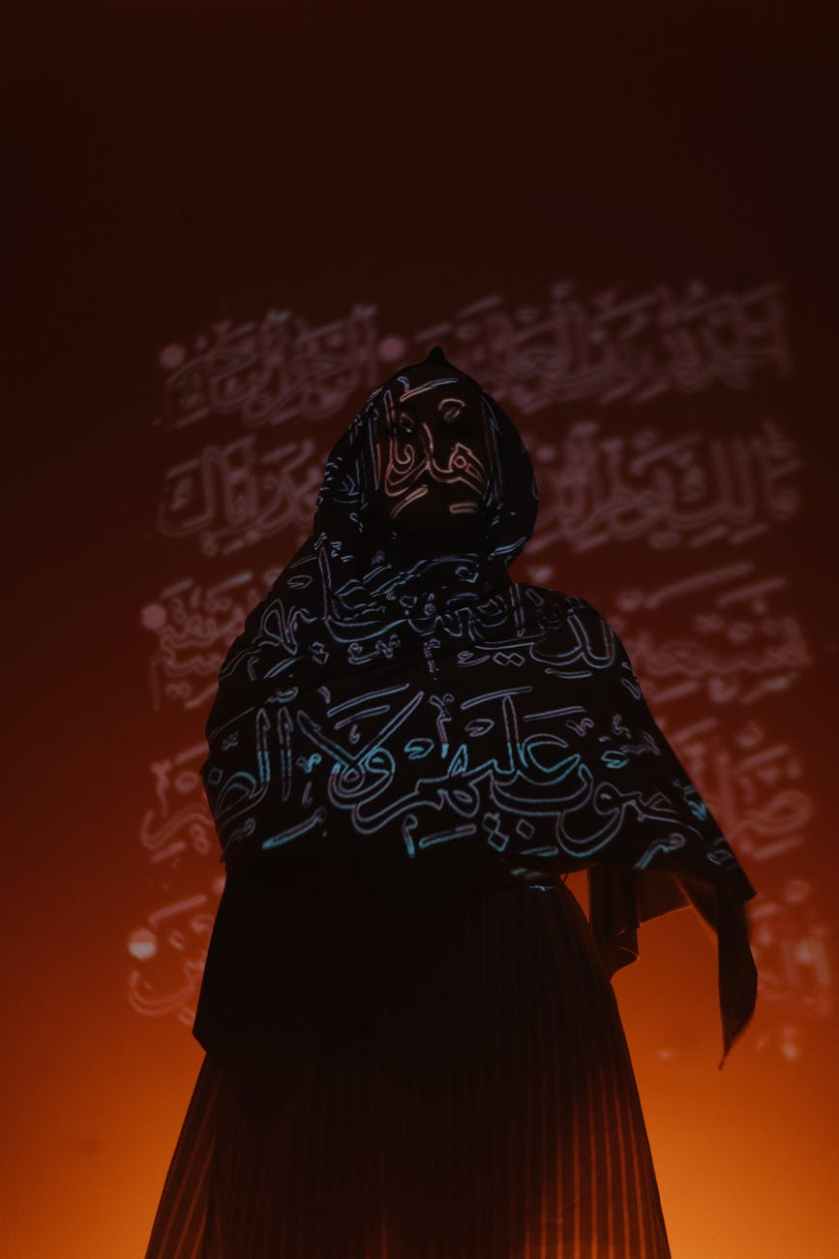
“At moonset
I was born
Dawn leaned over the universe
And night’s breast
In rage tore its tunic.”
~Malika al-Assimi
—
The women are for expansion. Sinuous, flexuous, their gentle force pervades through the motley Silk Road, at moonrise, at moonset, captured in the archaic record of the times and sealed in the arc of the human story. A woman’s story.
The archaic Muslim woman. Muse of orientalist writing: the literary cannon across time and distance; folk tales and oral traditions; beguiling the senses of male poets; and perplexing the ethnocentric gaze. Yet what was the lesser explored reality of the Muslim woman of the Medeival period and the Middle Ages, the woman who was infinitely more than a captivating and well-documented beauty and object of desire? Who were the woman merchants of Abbasid Baghdad; the caravan investors of Damascus; the property-owning widows of Cairo; and the brains behind marriage alliances through which salient and pivotal trade networks would proliferate and flourish? The powerful women from grasslands of Central Asia to the oscillating deserts of Northern Africa, who moved and shook the mercantile trade, and changed the Silk Road perhaps in the epoch and perhaps again forever.
Well-meaning but often myopic binaries, absolutist platitudes and reductionist intellectual canyons have sought to downplay the role of these women in public life, commerce and in their wider societies. Yet the tradition of Muslimah strategists, estate managers, and contract negotiators date back to a time centuries before ours where the woman’s concentricity to Allah swt did not negate her right to financial acumen, stability, economic strategy and generational wealth should she so choose.
Women in Abbasid Baghdad
During the Middle Ages, Baghdad was central to trade on the artery of the Silk Road, an ancient maritime and land trade route between China, the Mediterranean, India and Persia. Imported and exported goods would be traded along the Silk Road including but not limited to silks, spices, grain, incense, precious stones, as well as more amorphous exchange:thought; religion; intellectual innovation; and technologies.
Zubaydah bint Ja’far and Silk Road and the foundations of Infrastructure
Dr. Siham Jamil Jasim of Anbar University reports that at the time of Abbasid Baghdad, women were an essential pillar in supporting their families following the instability and high cost of living of the times. Beyond common crafts practiced by women such as: spinning encouraged in religious and intellectual circles at the time which were sold by the women or by the men in their families on their behalf; perfume making sold to the general public or alternatively for elite households; fabric dyeing where women would move between homes and perform their work; and the selling of cooked goods at local markets, women would also be small scale merchants and shop owners, converting a part of their homes into small shops to sell to their neighbors as well as local market places (1).
Beyond the quotidian small-scale trading of these women, however, were the major movers and shakers of the Silk Road. Zubayda bint Ja’far a prolific and philanthropic Abbasid Princess and wife of Harun-al Rashid was central to the expansion of public works and routes that transformed the Silk Road. Upon seeing the extent of drought in Mecca post completing her Hajj pilgrimage, she ordered that the well of Zamzam be deepened and in the harsh and arid surrounding province: the construction of an aqueduct from the spring of Hunayn, 95 kilometers to the East and on the plain of Arafat- the Spring of Zubayda. Princess Zubayda would spend 2 million dinars to improve the water supply to Mecca and would also go on to finance the construction of a 1500-kilometer road from Kufa, South of Baghdad to Makkah paving the desert and clearing boulders (3). This was constructed with hilltop fire beacons to guide night travelers and at regular intervals, more than 50 water stations of wells, dams and reservoirs for travelers on the road. Zubayda’s public works and innovation in creating this well-resourced artery through Baghdad to Mecca functioned as a pivotal branch of the broader Silk Road network and became a major commercial route joining Iraq with the Arabian Peninsula, facilitating the export of Arab products and bringing goods from China, India and beyond to the Arab world (4).
Other notable roles for women in Abbasid Baghdad were the Qahramana (Harem Agents) who acted as agents for upper class trade, managing business and commerce on behalf of royal women and liaising with merchants and tradespeople to purchase goods. Notable Qahramana’s include Qaharnmana Zaydan (5) who held massive control and influence oftrade and property and Umm Musa who was the intermediary for mother of the Caliph al-Muqtadir. More common roles were the market inspectors Muhtasib – ordinary women in the marketplace who ensured that trading followed state regulations (6).
Caravan investors in Damascus
Male Sogdian merchants from the ancient Iranian civilization Sogdiana were often travelling for years at a time for trade along the Silk Road and in major trading hubs such as Damascus. The women of Sogdiana who were largely Zoroastrian, Buddhist and Manichaean and who in the latter period of Sogdiana’s history became predominantly Muslimduring the reign of the Samanid Empire, would be left to assume the local business interests of their husbands as well as manage the household estate. Beyond this, Sogdian women would be self-made business women independent of their husbands, through strategic economic marriage alliances across key trading points along The Silk Road and by acting as women-merchants, managing significant capital, signing and drafting multilingual trade contracts, managing credit systems and upholding their legal rights when suing for debt incurred (7)
Property-owning widows in Cairo
Women of Fatimid, Ayyubid and later Ottoman Cairo, a crucial trading post along the Silk Road, often used inheritance systems to secure their wealth, and control their estates and assets such as agricultural land:
“Historically speaking, the lands of Egypt were known to have been bequeathed by the peasants to their heirs prior to the Mamlūk period. Studies of the Ayyūbid and Fāṭimidperiods suggest that agricultural land was inheritable, so that women had access to the land in those times.” (8)
Later in Ottoman Egypt, the Ottoman qanun which restricted women from inheriting land was met with resistance from ulema and peasants alike allowing women to inherit agricultural land:
“Although this qānūn conformed to the Mālikī and Shāfiʿī madhāhib’s claim that land was in public, state ownership, late Ottoman scholars of both madhāhib decided to diverge from their early doctrine. They found that the legal ramifications of their madhāhib had become pernicious to the rights of peasants and women. Therefore, many of them decided to claim that land was no longer owned by the state, but that it was privately owned by the peasants. This new doctrine allowed women, at least in theory, to inherit agricultural land similar to men.” (8)
—
The women of the Silk Road were forthright, multilayered, shrewd and intellectually venerable. Heirlooms of a country, a time, and now dilapidated metropoles, these women of past look into us and us into them. The timeworn lake refracts their abiding light and one day, ours. Cartographies that pervade our present day society seem to skew us from the correct bearing that reflects the reality of Muslimah’s in public life, and looking back, reaching for whispers of the ancient, the archaic, present a more accurate portrayal of what it means to uphold the rights of Allah, and uphold just as closely the rights of the human intellect. Indigenous to women’s fitrah is what we find so pervasively reflected back to us: that we are beings admired for observable radiance, and yet these women were emblematic of both types of autochthonous luminosity which like a thousand midnight harvest moons, continues to break the path for us to become.
References
1 Malikia Al Assimi, https://pierrejoris.com/blog/from-the-diwan-ifrikiya-anthology-malika-al-assimi/
2 The Crafts and Professions Practiced by Women in the Abbasid Period 132-656 AH / 750-1258 m., Journal of Tikrit University for Humanities, https://jtuh.org/index.php/jtuh/article/view/728#:~:text=Abstract,support%20themselves%20and%20their%20families.
3. Women Rulers of the Arab and Muslim World: Khayzuran and Zubayda, Tom Verde, https://egyptianstreets.com/2016/01/20/women-rulers-of-the-arab-and-muslim-world-khayzuran-and-zubayda/#google_vignette
4. World Heritage Site https://www.worldheritagesite.org/tentative/the-darb-zubaydahsaudi/#:~:text=Connections%20for%20The%20Darb%20Zubaydah,Status%20Nominated%202027%20Site%20history
5. The Vizier and the Harem Stewardess. Mediation in a Discharge Case at the Court of Caliph al-Muqtadir, John Nawas, https://www.academia.edu/715340/The_Vizier_and_the_Harem_Stewardess_Mediation_in_a_Discharge_Case_at_the_Court_of_Caliph_al_Muqtadir
6 The Abbasid Caliphate https://islamichistory.org/the-abbasid-caliphate/#:~:text=Because%20of%20this%20growth%20in%20commerce%20the,dishonest%20practices%20of%20all%20sorts%20were%20avoided.
7 Sogdian Women on the Silk Road: Religious Syncretism, Commercial Agency, and Familial Power in Eurasian Cross-Cultural Exchange, Zirui Lu, https://www.researchgate.net/publication/393613540_Sogdian_Women_on_the_Silk_Road_Religious_Syncretism_Commercial_Agency_and_Familial_Power_in_Eurasian_Cross-Cultural_Exchange
8 Muhammad al-Marakeby, Could Women Own Agricultural Land? Rethinking the Relationship of Islamic Law and Contextual Reality (Wāqiʿ), https://brill.com/view/journals/wdi/63/2/article-p184_002.xml

Soukeyna O is a writer based in London. Her work can be found here: http://www.Soukeynao.co.uk
 MZAB
MZAB 