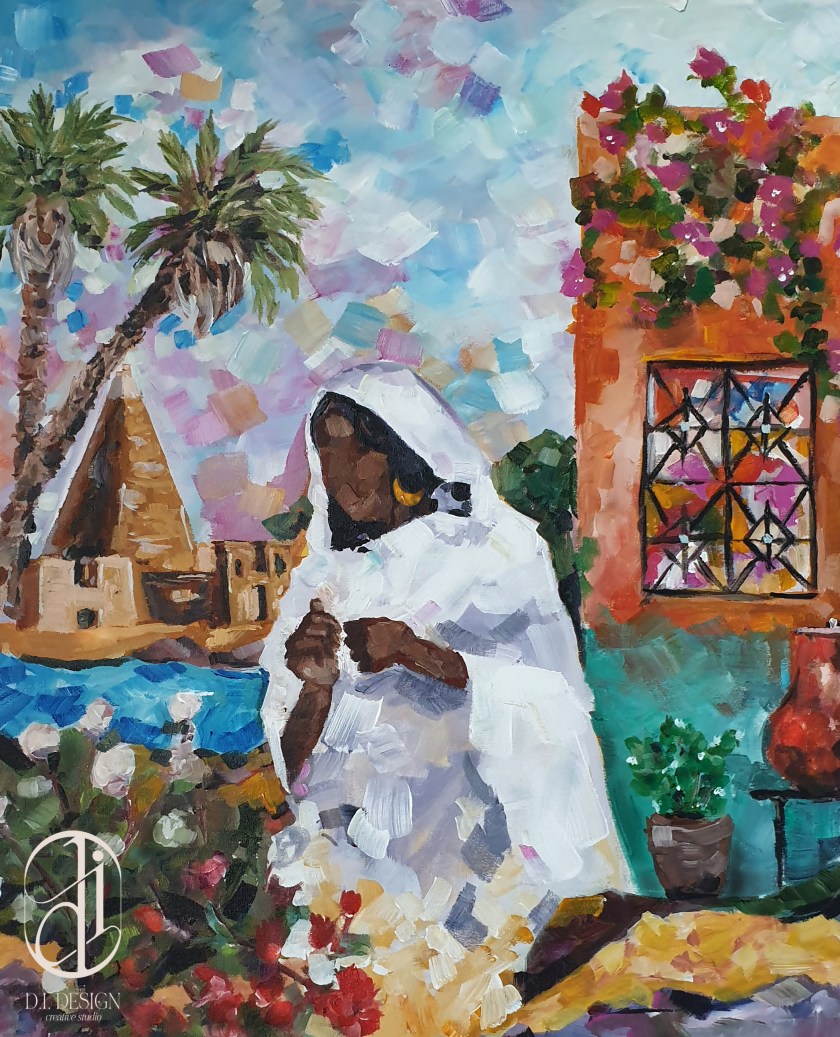
Dalya Ismail is the founder of creative studio D.I. Design and is an interior designer and artist of Sudanese origin residing in the UAE. Read below as we caught up with her on her formative years, lines of poetry she lives by and the sanguine years she spent in Sudan.
Thanks for allowing us to interview you Dalya, at MZAB we love your art, and the culture you represent. Tell us more about your upbringing, what got you involved in artistic expression and turning points in your formative years that influenced your work
Thank you so much! My upbringing played a major role in my art and design journey having been exposed to many cultures and ways of being all my life. I was born in the US, spent my formative years in Sudan, then moved to Sultanate of Oman. I spent my late teen and adult life in different parts of Canada and currently reside in the UAE.
Despite the heavy influence of my travels on my current artistic expression, it was those few years in Sudan with my family and grandparents in our family home where the spark of love for art and design happened.

I remember one day I was laying on the floor with a paper to draw my grandfather from a framed picture that sat up on a shelf, I was probably about 7 or 8 at the time, I became so immersed in the drawing mentally and emotionally. It was this bright moment of discovering something I really enjoyed and could do that has stuck with me ever since!
I was always very spiritual and observed things around me in a way that left me feeling alienated. I felt things very deeply and it took that drawing of my grandfather to discover the power of channelling. Upon seeing my artistic interest, my father bought me all necessary supplies including instructional videos called “ Yes, you can draw”. The support and encouragement of my parents was vital to my growth artistically. I continued to spend hours drawing and felt the ability to pour my heart out into something I create gave me a sense of peace and being grounded.
Your name is beautiful- in many faiths and cultures, naming is a huge part of someone’s nurturing and destiny. What does the translation of your name mean and how has it held significance for you?
Sharing beauty and softness with generosity is what I hope to do, especially through my art.
Growing up I thought I was named Dalya as a reference to the ‘Dahlia’ flower, and while that is one meaning, I grew to discover that in Arabic and other languages it translates to the slender generous branch that bears fruit like grapes or olives. It also refers to gentleness, softness, and beauty. You are right about names being a huge part in someone’s destiny and nurturing, I knew that growing up but I didn’t connect with my name positively. To be honest, when I thought of the flower, I thought of it in negative connotation like weakness, sensitivity, and a quick death; dramatic I know! However, later, during the end of my university years, I had to sit with myself and build a love for my name, search for its deeper meanings and work hard to embody them. It had to come by way of deep spiritual learning at the same time. Sharing beauty and softness with generosity is what I hope to do, especially through my art.

What are your fond memories of Sudan and Sudanese cultural ritual you often practice?
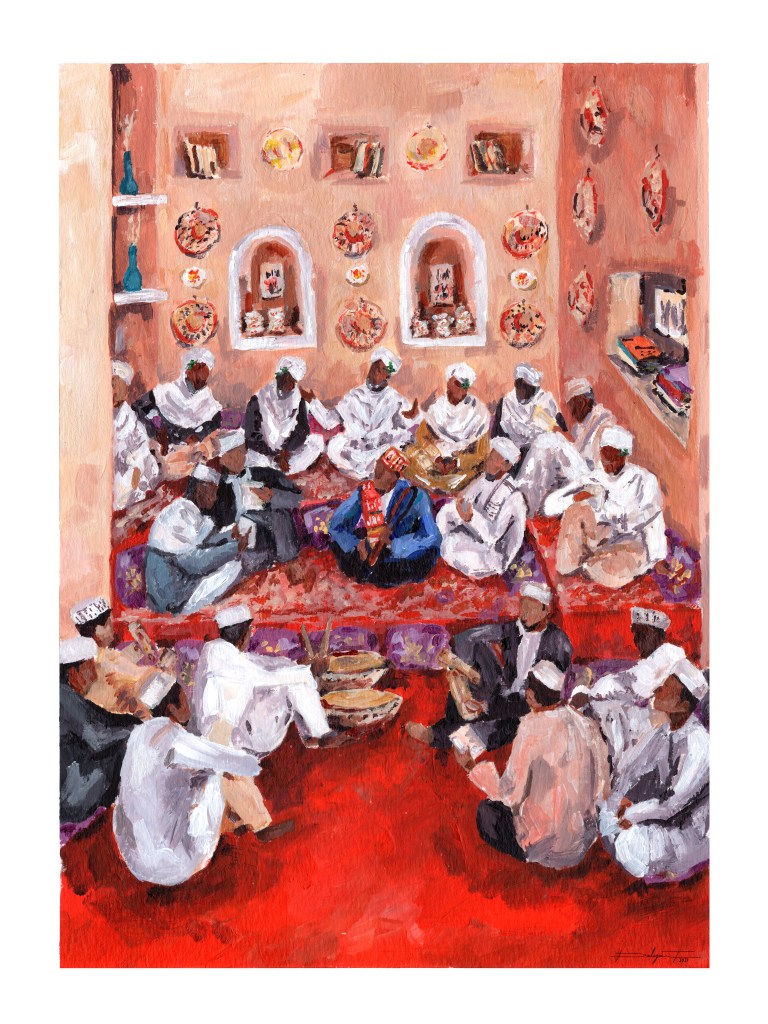
Even though I only lived in Sudan for a few years when I was young, we maintained very strong ties because going back to Sudan every summer was a family tradition. Some of my most fond memories of Sudan that are an integral part of all Sudanese households is big family gatherings on Fridays. The rooms drown in the scent of our Sudanese Bukhor only to be overpowered by the smell of food, sounds of side conversations, and laughter.
One of my most cherished memories is waking up early on summer days with my grandmother to have tea with milk and a side of biscuits. As I sat on the floor by her bedside, she would tell me stories of her life growing up; the Sudan she knew. Just before the sun goes down, we would dust our front garden ‘Al Hosh’ with a special Sudanese broom, then spray it with water resulting in a heavenly mud and water scent that lingers. We would prepare outdoor beds and seating for after Maghrib tea and have an emotional readiness for family and guests to come at any moment. Sudanese doors are always open, visitors will come anytime especially if the home had a family elder. In this case, my grandmother was the queen of our home.
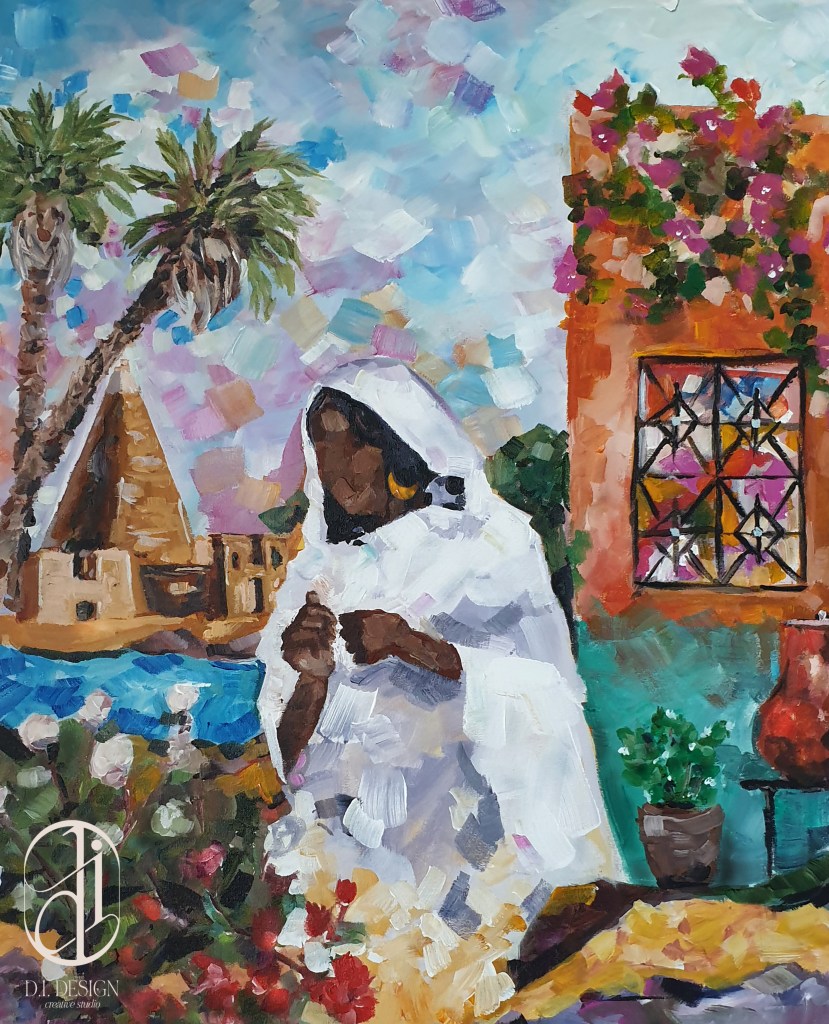

We still uphold many of these traditions wherever we go. Our community is very tightly connected, an elder would ask upon meeting me who my parents and grandparents are and they are bound to find a connection to bring us closer. We are holding on tight to our connections and traditions, until we can go back home again God willing.
Which painters, artists and art movements have influenced your artistic style and why?
I was always fascinated by Impressionism; the intentionality behind every brush stroke to create a lose image that captures a candid moment in stillness yet implies movement in the strokes at the same time captivated me, I loved the styles of Monet and Renoir. Since I come from an architecture and interior design background, the Bauhaus movement also influenced my creative process; the idea of bringing together and bridging all the creative disciplines under one roof made sense to me. Collaboration with other creative has naturally become a stepping stone in my studio.
In recent years, however, I am finding myself leaning back into my identity and culture as the core of my inspiration. There is a yearning to further explore not just Sudanese heritage but African and Muslim heritage as a whole.
Some Sudanese artists I’m currently learning more from are Ibrahim El Salahi, and Kamala Ibrahim Ishaq.
Is there a quote or line of poetry / prose that you live by?
Poetry is an integral part of my inspiration and work, When I’m stuck, poetry is one of the first places I turn to. My first love is Arabic poetry and if I had to choose poetry lines it would have to be by Imam Ali ibn Abi Talib (Ra) who said in his Diwan:
“Your remedy is within you, but you do not sense it. Your sickness is from you but you do not perceive it. And you presume you are a small entity, but within you is enfolded the entire Universe”.
I painted a piece especially for this quote along with the Arabic calligraphy which hangs in my living room. It is a constant reminder to look deeper as we go through the different highs and lows of daily emotions, and ultimately turning inward to the depths of the soul through self-watchfulness.
Tell us more about your artistic career, D.I. Design and your plans for the future
I started my studies in Architecture in Canada, then switched to interior design. During this time and until I graduated, I preoccupied myself with my studies and was not doing any creative work or painting aside from what was related to my program. After I completed my studies in interior design, I felt some a kind of void. Although I love interior design and am very passionate about it, it felt like something was missing. I did not realise I was supressing something that meant so much to me on a deep spiritual level.
When I became a mother, it opened up something within me in a positive way. I got two large canvas and just lost myself painting them in the span of a day, the first painting was titled “childhood dreams”. My daughter’s birth reminded me of who I am. It was after these two paintings that D.I. Design started.
I began doing all kinds of projects including Interior design, graphic design, and participating in small art exhibitions in Calgary.
The growth of D.I. Design has been soft and steady as I was also working in an interior design firm at the time. In 2018 I started dedicating my time solely to my art and collaborative art projects. My plan is to one day reintroduce aspects of interior design back into my work. I strive towards collaborating in more cultural books, children’s books, and getting deeper footings in cultural and Islamic heritage through the arts.
What is a project you have completed that you are most excited about?
One thing I love about art is not only how it evokes emotion but also how it has the power to connect us and bring us closer. I worked on a collaborative project with an amazing team of creatives who were interested in preserving their Harari culture and traditions through a series of books that included illustrations. Volume I and II have been published, the books are titled: Threads of Memory, Harari cultural ceremonies. To take part in and help in cultural preservation and education has truly been an enriching experience for me. I was able to draw parallels and intersectionality between our Sudanese culture and Harari culture from both Islamic and cultural perspectives.
Many of your paintings are acrylic on canvas- could you tell us more about why you have specifically chosen this medium for self-expression?
I find acrylic to be a versatile medium; being water soluble, I am able to control the flow and adjust the drying time speed by adding thinners, dilutants, or other mediums. I love that it allows me the option of making my paintings look very soft and blended, or loose with prominent defined brush stroke. I am also able to control the thickness of my layers. An added bonus to acrylic is that it is very forgiving, I can easily make a change and paint over something in minimal time.
While for now acrylic is my go-to medium, I do believe in exploring other mediums to enhance technique and skill. I am hoping to work with oils and gouache in the near future.
For myself and many others, art is a healing and a kind of therapy for the ugliness that the world can sometimes bring. What are your thoughts on keeping beautiful objects and staying in beautiful surroundings?
We are wired for connection and the appreciation of beauty. Art is definitely a form of healing and at the core of it we find a sense of ‘meaning’. We appreciate art and beauty through our own lens of perception and this bleeds into our ways of living and our surroundings. Interior design is a big part of me and influences how I view the lived environment. However, after I took time to focus solely on the arts, I found myself fascinated with the idea of the ‘healing environment’.
Having beautiful objects is not just about aesthetic, but that deep connection and meaning the object holds which gives it beauty. If there is intentionality and reverence for the space, any object placed that speaks to culture, identity, and spirituality, will start to create a sort of language. One that anyone who enters the space can sense; a beautiful code almost. We connect with spaces that allow us to experience love, wellness, spirituality, and creativity. All these elements come together to create that healing environment. Art therefore becomes not just a beautiful object or painting on a wall, but something that triggers a memory, a feeling, and a spiritual connection. It helps us feel more grounded in the midst of chaos.
Finally in your opinion, what does the future hold for Sudanese and diasporic Sudanese artists and how do you think they will impact the art world?
When I started my social media, it was as a way to connect with other creatives, but specifically other Sudanese creatives in Sudan and the diaspora. I have to say I was mind blown by the many Sudanese artists, filmmakers, musicians, writers etc.
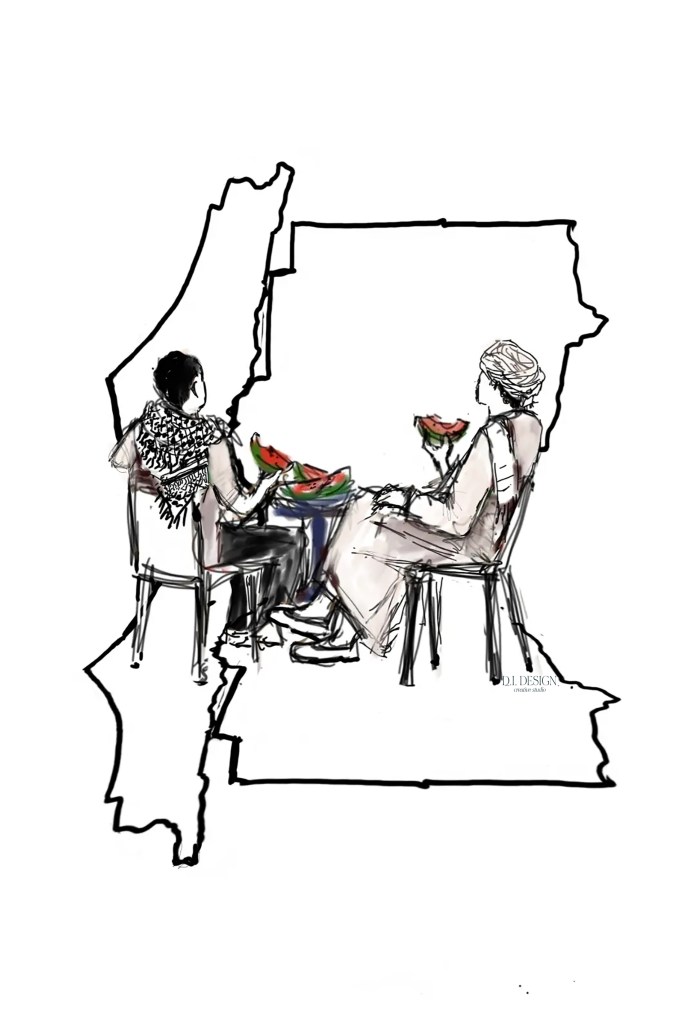
I was, and still am, very proud of the Sudanese creative scene. Especially now after the war, it really has reinforced the will and determination of all Sudanese creatives. I see the future for the Sudanese art scene as becoming a stronger influence within the international art community having a very visible and tangible imprint.
The Sudanese people have stories to tell, and Sudanese artists will cross borders and tell those stories through all forms of artistic expression.
In Conversation: Artist Dalya Ismail on Impressionism, the Nostalgia of Sudanese Kinship and the Destiny of Names
Tweet

Dalya Ismail is an artist, interior designer and founder of creative studio D.I. Design. She is based in the UAE and can be followed on Instagram @d.i.design.
 MZAB
MZAB 