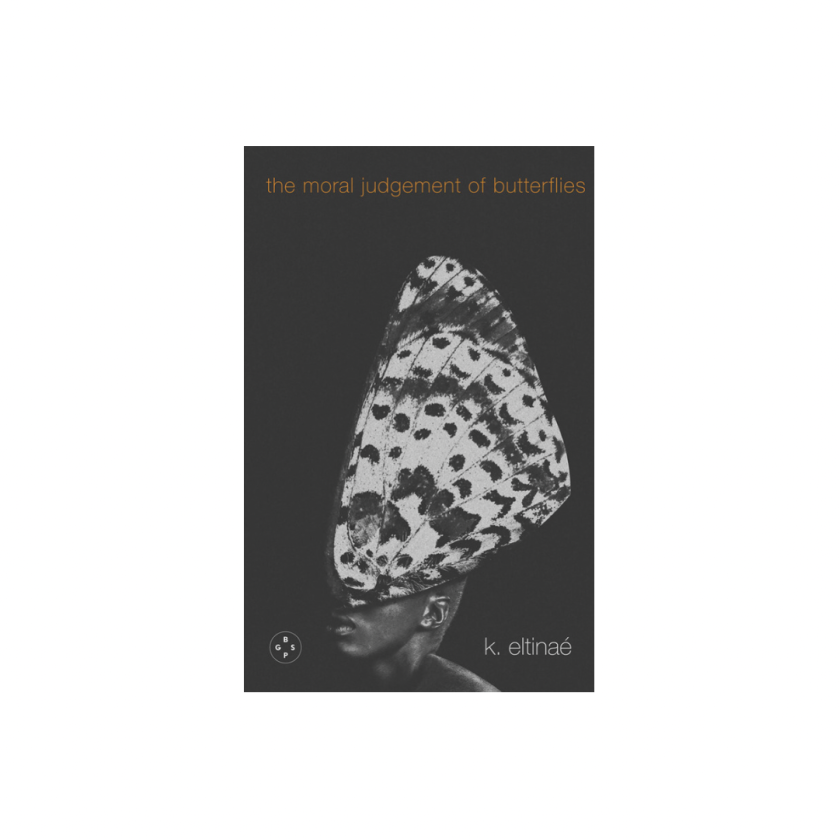
k.eltinaé is a Sudanese writer of Nubian descent and a third culture kid who with his poetry collection, negotiates borders and ideas as adroitly and beautifully as the argonaut that is the butterfly.
Vacillating between love and longing, displacement and arrival in his profound collection titled ‘the moral judgement of butterflies’ k.eltinaé’s body of work is at once arresting and searing, spiritual and heart wrenching.
As my copy of his collection arrives, I eagerly open the pages to mine the words which have captured the startling rage, love and poetic musings of a writer who from culture to migration, war to peace has a lot to say about and to the world.
–
‘nefsi’
I am upon the first reading drawn to read and re-read the poem ‘nefsi’ (translated from Arabic to mean ‘my soul’, ‘my own self’). For those that are on their own journey to self love / acceptance / those who are battling the troughs of their own minds and seeking words of affirmation which are just as impactful as West Indian writer Derek Walcott’s ‘Love after Love’, ‘nefsi’ is a poem which masterfully advises and consoles, gently reprimands and entreats the reader to recognise the inherent value in themselves.
“You mustn’t mine for love, petrol or diamonds.
Tend to the wealth and splendour in your laughter.
Be selfish with your love.
Stock simmer, seal in jars
for winter, all year long.
Keep your love.”
k.eltinaé’s eloquence and craft is captivating. It was Joan Didion who wrote “we tell ourselves stories in order to live.” Indeed the story k.eltinaé inks in ‘nefsi’ implores us to live, not for the promise of external validation, but more importantly for the healing, for the satiation of our innermost child with a reminder and adulation of everything that is great about ourselves. It is a poem I will be returning to over and over.

In a previous interview with MZAB, k.eltinaé tells us that his writing and creative literary pursuit is ‘drawn from the cadence of language’ rooted in his love for music:
“I had a real love for debut albums rushing to the mall buying tapes pouring over lyrics, and carefully assigning every artist what I felt or believed was their signature sound. I guess this idea that I would later learn is loosely called ¨voice¨ in creative writing, really influenced my own journey in discovering my own voice.”
k.eltinaé’s voice throughout his body of work is one that is both nostalgic and unnerving – unnerving because of the frequent and sudden punctuations of decampment and generational trauma- the dual reality of belonging ‘everywhere and nowhere’, of finding place in the absence of it, of the injustice of having been rendered stateless.
“they still count days, months, years.
I think about those walls and their ears,
measuring every day how long it takes
to step out of the shower, tie laces, practice faces,
until I’m sent back to a place I fled
but never escaped.”
The above excerpt taken from the poem ‘exile’ sears with the angst of migration, with what W.E.B DuBois coined ‘double consciousness’ and the uneasy trepidation that is reminiscent of South African author Ivan Vladislavic’s writing. The juxtaposition ‘evils’ /’wanderlust’ from ‘Tomorrow/ I will find a phone booth and call home, / listen to threats about the evils of wanderlust’ in an earlier excerpt of ‘exile’ points to the opposing tensions k.eltinaé is confronted with in leaving his home country but remaining tied by ‘the ears’ he left behind.
His subjugation to a condition of statelessness and the iniquity of state bureaucracy after battling for legal status in Spain and being unable to renew his passport during Al-Bashir’s regime are additionally explored in the poems Native, Settle, Breathing Exercises, Illegal, Plans, Arraigo, Kindness, and Butterflies.
‘kohl’
A third poem I am drawn to reflect over is titled ‘kohl’:
“Is it still called asylum
when you race amid nightfall
setting camp under your own dust,
half dreaming you’re a zebra
because the marrow in your bones
won’t settle for land?
And what about the fear
strangers paint across faces
whenever you cough or share a path?
Who will defend the maps
taken from truth by lies?
Who will trace kohl for our eyes?”
The imagery in this poem is profound and powerful, exposing the reality of collective indifference and hostility towards migrants / diasporians and the desire for care in a society that is devoid of it. Maps and borders here are embodied in the physiology of asylum seekers whose very bones have become like the zebras ‘who won’t settle for land’ reminiscent of Momtaza Mehri’s poem ‘Glory be to the Gang Gang Gang’ where ‘birthmarks [are] shaped like border disputes’. The poem ‘kohl’ crystallises the reality of borders and boundedness being physically manifested into the very people that are restricted and suffocated by them, evoking in the grace that characteristic of k.eltinaé’s writing- haunting metaphors that quietly rage against what shouldn’t be- but has been accepted and reified as the status quo.


‘The moral judgement of butterflies’ is a political body of work characterised by resistance and nodding to the tribulations of the human condition across the subaltern and diaspora. It is also a work of healing and reconciliation- namely the cathartic nature of the writing in k.eltinaé’s own creative process crossed with assured observations about the reality of life – from matrimony to family- a quiet acceptance of small ironies: “She calls after work excited/ has met a girl with dimples/ ready to start a family with a modest man/ willing to marry a stranger/ who barely lives with himself.”
Laced with Turkish, Greek, Arabic and Nobiin, k.eltinaé expertly weaves his overlapping identities into a body of work which originated as an autobiographical oeuvre and metamorphosed into a collection that pays ‘homage to the Nubian Exodus’.
k.eltinaé, based in Granada is the awardee of the 2019 International Beverly Prize for Literature and holds an MA in European Literary Cultures. His collection can be purchased here . Follow k.eltinaé on Instagram @k.eltinae to keep in the loop with his work.
k.eltinaé, borders and butterflies
Tweet
 MZAB
MZAB 