Close that voice down in your head that’s telling you to prepare for a little bit longer or that maybe it’s not right at the right time and just do it.
Farha
MZAB magazine caught up with Farha Bi also known as Brown Girl on a Bike. Farha is based in Birmingham with Kashmiri roots documenting her cycling adventures through her Instagram page @browngirlonabike. We interviewed Farha about her culture, upbringing and key moments during her travels.
What is your full name and what does it translate to?
My name is Farha Bi and it means Joyful Woman. I think its root is Farsi but is found in Arabic and in Urdu as well. Bi is a common surname for women in South Asia, although I recently learned it’s also used a lot in China, with a different meaning.
Tell us more about your upbringing. What were the departure points, which shaped who you are today?
I am a brummie at heart, living in Birmingham until I was 18. I am also Kashmiri with both parents born on the Pakistan-Occupied side, at a time where there were no ‘sides.’
My dad came to the UK at 18 in the late sixties, my mum followed after marriage in the late 70s. I’m very, very proud of my Kashmiri culture, our traditional knowledge and my families lived experience – it has been a long journey for me to reconnect and reclaim pride in who I am and where I come from.
Being part of big family has also shaped me, I am one of eight. 5 girls, 3 boys – I am number 7. Being one of the youngest (and the youngest girl) has meant that I have incredible sisters and brothers, who faced many challenges head on, smashing through closed doors so that I am able to travel further than they ever had the opportunity to do. Everything I achieve is very much on their shoulders, strength and sacrifices.
We grew up in a very white, middle-class suburb of Birmingham and so had quite a violent racist upbringing. As probably the first brown Muslim family in that town, coupled with the fact that we were still very working class, we were often targeted, bullied and ostracised… It’s something that really stays with me. In the last 10 years, there is more space to talk about race, racism and the structural violence black and brown people experience. However, when I was a teenager or at university, if I would talk how my family were treated, I was met with a barrage of denials, constantly dismissed as exaggerating. Growing up in such hostility meant that we have a really strong family structure that I am really grateful for – my siblings became my best friends – and because there were so many of us, I legit didn’t realise I had no friends until I was 18!
Every moment in my upbringing has brought me to this place and moment today. However, there is a moment in my childhood that I like to think set me on course for ‘adventure’.
When I was 11, I was preparing to join my other siblings at Secondary school. Back in those days, you would get an automatic place in the school if you had family there. But I was number seven, so I think the school had had enough of my family and rejected me. With no places in any other local schools, it was decided I would have to go to the neighbouring County for school, over a 1 hour away. I would leave my siblings at the bus-stop and instead embark on a 20 minute walk to the train station and take a 25 minute train ride to Staffordshire. It sounds very dramatic. It wasn’t actually that far but to go to the school out of my city without my siblings- I definitely see that as a defining moment in which I was separated from my family. It was hard because I now stood alone, but it’s also gave me courage. Looking back- it was my first taste of independence and challenge.
We have been following your post for a while and somewhat living vicariously through you. What is the story behind you embarking on your cycling journey?
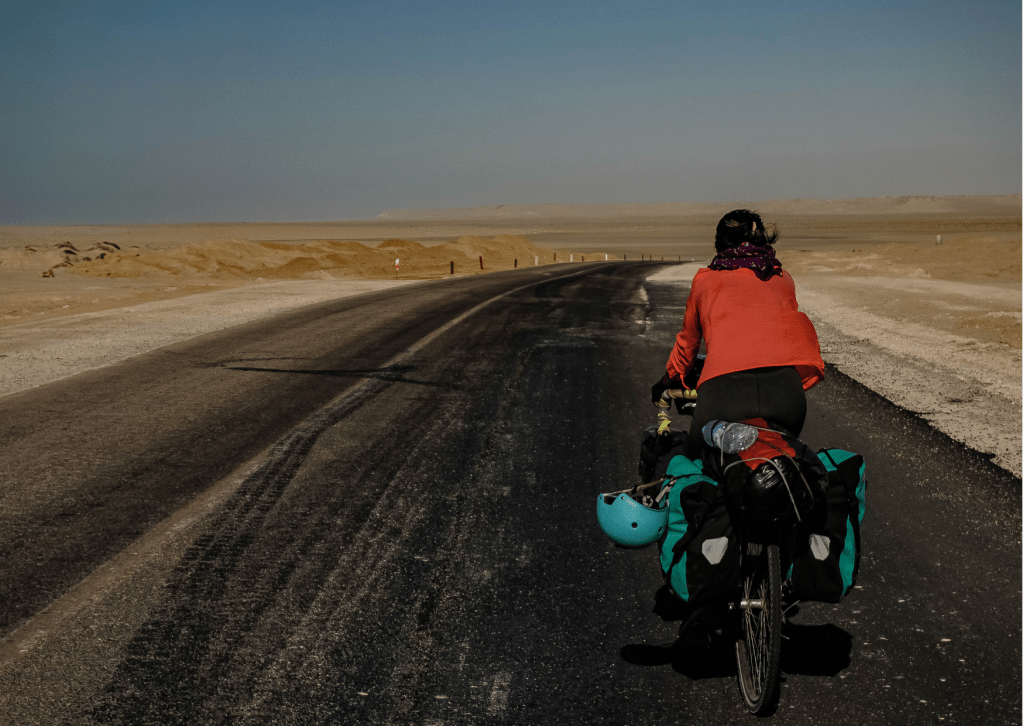
Many people look at my journey and feel really removed from it, as if it would not be possible for them. So I love to tell people that I only learned how to cycle when I was 22 and purely because it was cheap. Refusing to pay the ridiculous cost of London public transport – I bought a bike for £25 and decided I would get around on the road.
In 2010, there was not as much as cycling infrastructure and support as there is today, so I learnt how to ride through a 1-hour free session on road cycling and forcing friends to teach me (I was not a good student). Turns out I started to fall in love with the ride – really enjoying that I could get myself to places.
I began to go on longer rides with friends and realised cycling 50 miles was kinda the same as cycling 10! I met some people who went on longer rides and thought why can’t I do that? My friend and I went on a three-week cycle trip to the Basque country in Spain. It was the first time I cycled mountains and I survived…at this point I still didn’t even know how to use gears on my bike! I had been really interested in Persian history and Iranian culture so started to think wouldn’t it be lovely to cycle to Iran? The idea began percolating in my brain.
In 2017, I was working as a community organiser and youth worker in London. I was starting to feel jaded and depressed, unsure about whether I was making the structural change I hoped for and was looking for a way out. Wanting to quit my job, the random idea of cycling to Iran morphed into cycling the Silk Road, the Pamir Highwary all the way to China. Because no friends wanted to join me in quitting their job to go on a cycle jolly, the trip became a solo journey.
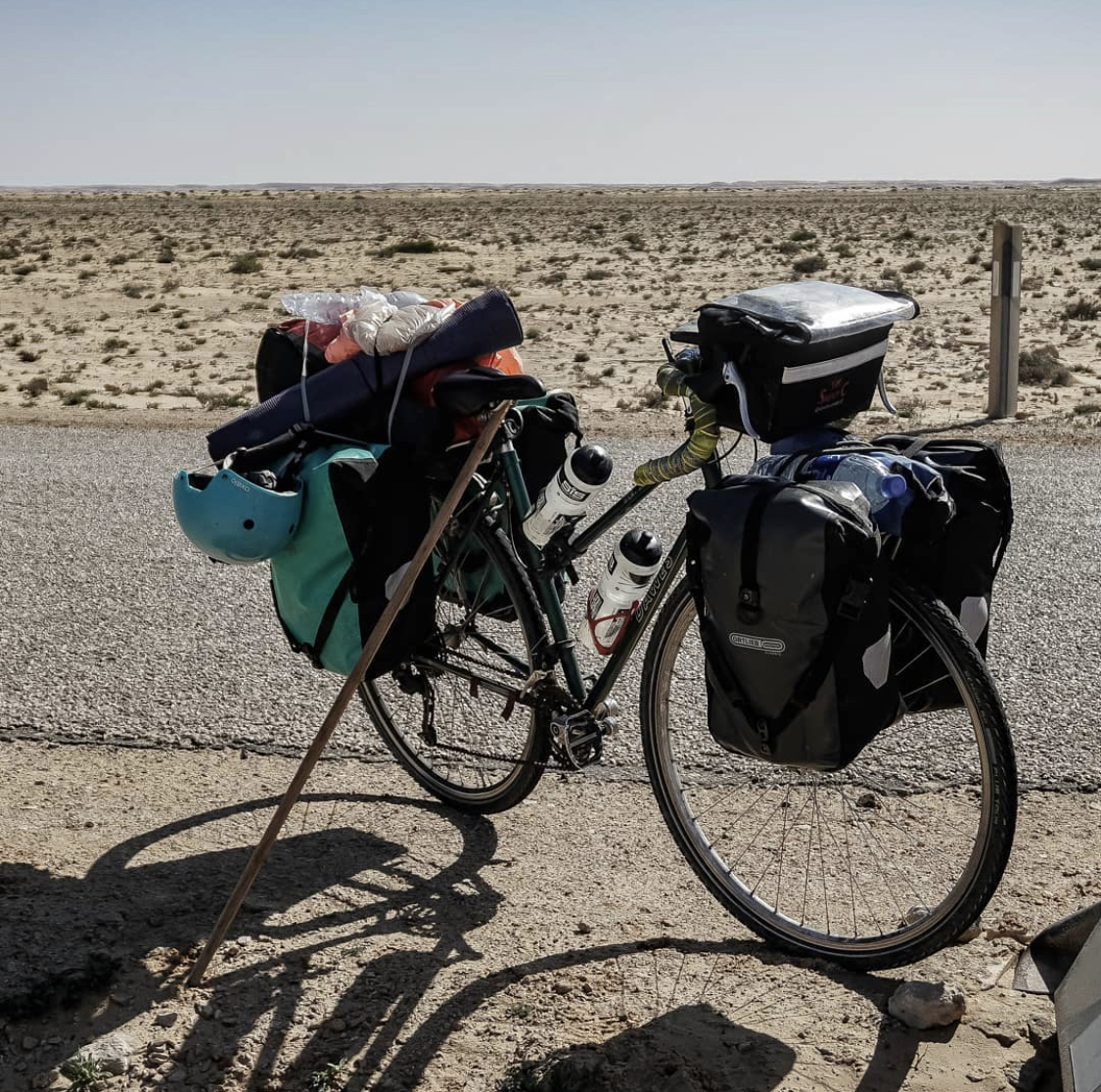


As I was planning and prepping routes, I found out I couldn’t get a visa to Iran which threw a big spanner in the works. And so, six days before I was meant to leave, I needed a new destination. Up until this point, I had been physically and mentally preparing for cycling through the Caucuses in winter which reaches -30C so when I had to pick a new place to cycle, my brain was like, I want to go somewhere hot! And so, I decided to go South, towards the Sun. As I started to move, the plan came clearly into my mind that actually what I should be doing is cycling to South Africa. I quickly started making calculations, mapping out distances to be covered and determined I would get to South Africa in 18 months.
However, soon after arriving to the African continent, my pace and perspective changed – I stopped counting miles and kilometres, it wasn’t about getting anywhere anymore. I became a little more non-directional and just kind of followed where I wanted to go. Some days I would cycle 5km when I would stop to spend the day at a waterfall I discovered. It led me to live in Senegal for 9 months. And that might not have been the most efficient route, it was the one that my bike and I wanted to take.
What has been your most impactful destination?
Gah, this is such a hard question. I feel like I got something from everywhere I went. In every village, in every city, in every rotation of the bicycle. I really feel that they’re all part of the same piece so to take one place or space out of it and elevate it as the most impactful, feels inauthentic to the actual experience.
However, pausing in Senegal was a real gift. I was suffering heat exhaustion and planned to recuperate here for a month. The month extended into 9 months with me getting a job, starting to learn Wolof and carving out a little life in Dakar. Also, having cycled through the Sahara Desert for six weeks, operating within an extremity that I was not used to it- I was pushed beyond – I felt like I had disrupted the way in which I had previously experienced this life, and had access to a different way of thinking and seeing the world, which continues to live within me today. It was a pretty powerful experience.
What is a place or a person on your travels that you can never forget?
When I was cycling in the Atlas Mountains, I came across a beautiful lake and decided to stay the night. I started preparing my tent when a Shepherd visited me – we’re in the rural mountains in Morocco, he had his herd of cattle and he sees me and comes over, with neither of us speaking each other’s tongue, we communicate through sign language and some broken French.
As we ‘talk’, he realises I plan to camp at the lake and invites me to camp with his family. I always try to say yes and accept what comes my way when I travel, so I repack my tent and walk to where his family are, setting up my campsite for a second time that day, this time next to his more established Bedouin tent. I meet his wife and small baby, and together we sit, we drink sweet milk, and we have some bread. We sit and they share photos of our respective families – it turns out they actually have four other children that are living with grandparents closer to the town so that they can go to school.
Soon after, their neighbours came, and we continued to sit and drink tea – sometimes in silence, sometimes sharing pictures. Sometimes they would be in rapid conversation with each other, and I would listen to rhythmic tones that I understood on a deep level. When I awoke in the morning, my new friend had already gone out with his cattle, so I packed up, said goodbye to his wife and set out cycling.
It was just this really loving evening.
Each day I experienced this wholesome human interaction, offers of love and friendship from almost everyone I met. My heart contains photo albums of every person I met and spent time with.

What is some advice you can give to someone who wishes to follow in your footsteps and take to the road like it?
Just do it!
Close that voice down in your head that’s telling you to prepare for a little bit longer or that maybe it’s not right at the right time and just do it. I had all those voices in my head, and they made me not go earlier than I could have done. Solo slow travel is such a gift as you get to move at your pace, transition into a state of being rather, get to see how to seasons and cultures shift and blend into each other and of course, you connect with everyone you meet and nature in a profound way. You may be solo, but you are never alone.
Farha can be followed on Instagram @browngirlonabike.
Vanguard of Exploration: Farha Bi on the Road
Tweet
 MZAB
MZAB 